My photo
I am an artist who has lived in Los Angeles, New York City and, now, northern California. My initial interest in art was provoked by the Asian collection at the Seattle Art Museum when I was in high school, and it has continued to this day. I am not a collector, merely an admirer who has picked up the odd scroll, print or seal. Seals especially have engaged a deep involvement and I welcome this opportunity to share. For my own primarily sculptural works please visit my website lorenmadsen.com.

gourd seal


A small seal in the form of a gourd. Haven't done any translating on this one yet.

rhinoceros cup seal


In the old days drinking from and collecting cups made from rhinoceros horns was the rage (seen a rhino in China recently?). Rhino horn also confers longevity on those who consume it. This seal commemorates that tradition by taking the form of a rhino horn.
Inscription plays on the longevity idea by comparing the age of "South Mountain" to that of a young pine: 壽比南山不老松 shou bi nan shan bu lao song (it means, ie, ever young). The carved decoration on the 'horn' is also of mountains and pines.
Impression simply: 八十翁 ba shi weng "80 year old man." He was hopeful.

happy heaven


This one is curious and cool. The top is carved like it was meant to be printed, but it is not. It says, in a perfectly readable way without printing, 歡天 喜地 huan tian, xi di something like: happy heaven, happy earth. The same is written in regular Chinese on the side, plus the word 'seal.'

Impression 墨汁因缘 mo zhi yin yuan is harder to render into an English phrase. Literally it says 'ink stick, fluid, reason, fate' which is kind of like 'born to write (or paint)'.

Sealscript fan by Li Jia-fu


I love not only the seals, but also the script, called zhuan shu, seal script.

This fan was made by Li Jia-fu (1829-1894) in year 10 of Guang-shu (by Chinese traditional reckoning), which would be 1885. The inscription in regular script, on the left, explains the occasion (approximately): Last year I happened to record my humble composition. I'm presenting this to my noble brother (an honorific--probably his host) for comment.

The seal script text basically says: When I went away to the north valley from the capital to escape the heat (on vacation), I saw birds and a river and rocks, etc. and I forgot the heat. I made this humble picture/poem.

It was common among the traditional scholarly aristocracy for a guest to give a gift to a man who hosted a visit, which were often quite long. The reference to a picture-poem suggests there may have been a drawing on the verso of the fan. It's not there now I'm sad to say.
(Thanks to Candice Lee for the translation)

jade boy


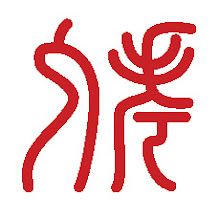
A small boy lies on his stomach on a plinth or stool decorated with lucky bats. No side inscriptions on the heavy and hard stone, and even the impression was very hard to make out. I include the actual back-and-forth worksheet that Alan Ho and I used. 
Impression: 吉如祥意 ji ru xiang yi, Good peace and wishes be granted unconditionally.

abstract lion


A stalwart lion, highly abstracted in an almost cubist way. No side inscriptions or date.
Impression: [literally] hall encompassing ancient artifacts, which probably means 'collection'

jade(?) seal


I'm told that this is jade, which is a very hard stone. Maybe... A beautiful stone in any case. Most jade seals were owned by emperors and such. More info soonish.

Seal in the shape of a book


A seal like a book with the cover folded back. You can see the "printing" and even worm holes.

Inscription: gui you (1933, 1993); Chinese new year; [either a name] Fu Chang [or a description] lucky workshop.
Impression: [on left] therefore made; [on right] ??

Buffalo


A seal with a reclining buffalo. I haven't attempted to translate inscription or impression.

Bamboo


Thanks to Yugan—once again—we have definitive info including, incredibly, a photograph of the carver, studio name Mu Fu, given name Huang Shi Ling (1849-1908).
Inscription: 牧甫刻 Mu Fu ke, carved by Mu Fu
Impression: 1st character is 如, ru or 吳, Wu, but 2nd character is still illusive.

120 Chinese 'shous' in Leloatong


Here's the story: These scrolls---4 of an original 6---were owned by a collector of antique Chinese books and "the four treasures of the study (inkstick, inkstone, brush, and paper)." The title of the piece is "A Collection of 120 Chinese Character Shous in Leloatong." The scrolls were made by the seal engraver Sun Pan in the 49th year of the Emperor Qianlong (1784). Mr. Sun Pan is said to have collected the impressions of the character 'shou' (longevity) from many famous seal carvers of different dynasties, and added (in black) a short commentary for each. Supposedly this collection appears on p. 92 of the book "A Dictionary of Chinese Seal Characters," but I'm afraid to check it out. Probably a forgery (it's clearly old and re-mounted on new scroll backings) but a beauty in any case.

Anyone know anything? I'd be happy to email better photos if someone wants to work on this.

Japanese hanko


My one and only Japanese seal. A former student translated the inscription for me (I think the seal impression is the same): Take-uchi Kin-pei shi saku; Made by Mr. Kinpei Takeuchi.

Maitreya Buddha with his bag of blessings

   
Dimensions: 2.5"h x 1.6"w x 1" deep
Date: unknown
Impression: 汪 Wang; 士 Shi; 鐘 Zhong (the first three characters are the name); 曾 ceng (past tense marker); 讀 du (to read)
Read by Wang Shi Zhong

There are no identifying side inscriptions on this seal but the carving continues on all four sides of the stone where there are caves, lucky bats and other pleasures.
Many thanks to Yugan on the decryption.

Simple, elegant seal


Dimensions: 1"h x 1.3"w x 1" deep
Studio name: 大年 Da Nian
Given name: : Weng Da Nian (1811-1890?)
Inscription: 朗亭先生屬 大年 lang ting xian sheng shu da nian At the request of Mr. Lang Ting (signed) Da Nian
Impression: 沈兆霖印 Chao Zhao Lin yin , Chao Zhao Lin's seal (Lang Ting is Chao Zhao Lin's studio name)

Simple and elegant. The usual 'reading' for a seal is right column-top to bottom, then left column. This one starts top right and reads counter-clockwise


The Palace Museum Beijing, has a Da Nian seal online. They say the side inscription is his signature, but it says 均叔 Jun Shu. I dunno'

Seal in the form of a pile of books


Dimensions:
1.2"h x 1.3"w x 1.2" deep
Studio name: Shi Huo
Date: Gui hai (1803, 1863, 1923), 3rd month
Inscription: 長壽 增福 癸亥 三月 石火 chang shou zeng fu gui hai san yue shi huo long life, increased good fortune. gui hai (year), 3rd month. (carved by) Shi Huo
Impression: 長壽 增福 chang shou zeng fu, Long life, increased fortune

The seal depicts a multi-volume set of Chinese books, printed on lightweight rice paper with sewn bindings, a typical feature of the scholar's study.